Last Updated on November 25, 2026 by esiteworld
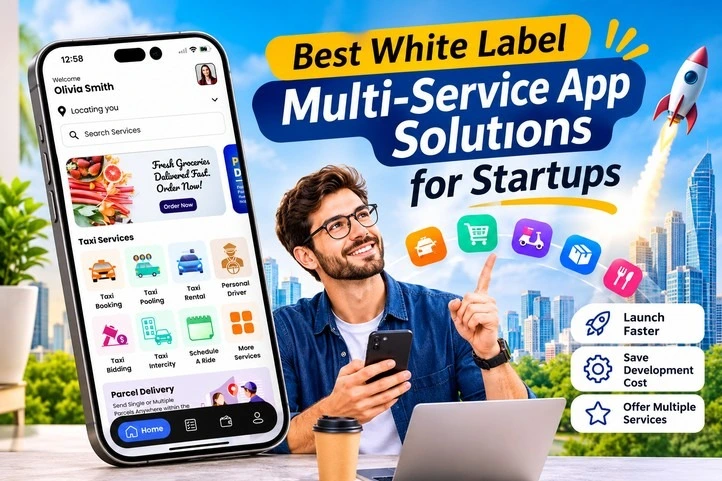
A single digital platform that offers multiple services enables startups to broaden their customer base and earn revenue in many ways. However, creating separate apps for each service, like taxi booking, grocery delivery, food ordering, etc., takes time, technical expertise, and funds.
Using a white-label multi-service app gives startups a chance to utilize an existing software foundation and customize it to their brands, services, and business needs.
Using this type of solution, startups have the opportunity to introduce one service to another without having to develop every feature from scratch, while expanding as the business grows. Startups have to make sure that a chosen solution meets the requirements while leaving an opportunity for future modifications.
What Should Startups Look for in a White-Label Multi-Service App?
Every platform possesses different features, technical capabilities, and flexibility. Startups must consider the following criteria when making a choice about the provider:
Multiple Service Modules
The platform must be able to provide the required services to be launched, such as taxi booking, food delivery, grocery shopping, parcel delivery, and home services. Moreover, it must allow adding other categories of services without rebuilding the app.
Separate Applications for Different Users
A complete platform requires three main interfaces:
- Customer application: To look for services, order them, pay for them, and track the order fulfillment process.
- Service provider application: To be used by drivers, suppliers, delivery partners, etc., to manage orders and bookings.
- Admin dashboard: To supervise customers, service providers, orders, payments, commissions, etc.
Customisation and Branding
The startup should have everything it needs to build its own business identity through a white-label super app. Customization options of premium importance are logos, colours, language, currency, and payment options, as well as service-specific workflows.
Payment and Third-Party Integrations
A platform should support necessary payment gateways, map services, GPS services, SMS notifications, and various other integrations required for daily workflow. All integrations should work properly for different service categories.
Expansion Capabilities and Security Features
The software should maintain its performance with the growth of the number of users, bookings, and transactions as the business expands. Security of data, secure processing of payments, access rights, and constant software updates are important.
Artificial Intelligence and Numerous Automation
The AI features can help to enhance some processes through personalized recommendations, prediction of demand, automated customer support, and data processing. The startups have to check which functionalities are included in the software and identify those that need installation or development.
Ready to Launch Your Multi-Service App? Contact Us Today!
Launch your multi-service app with our white-label solution. Contact us today!
Enquire Now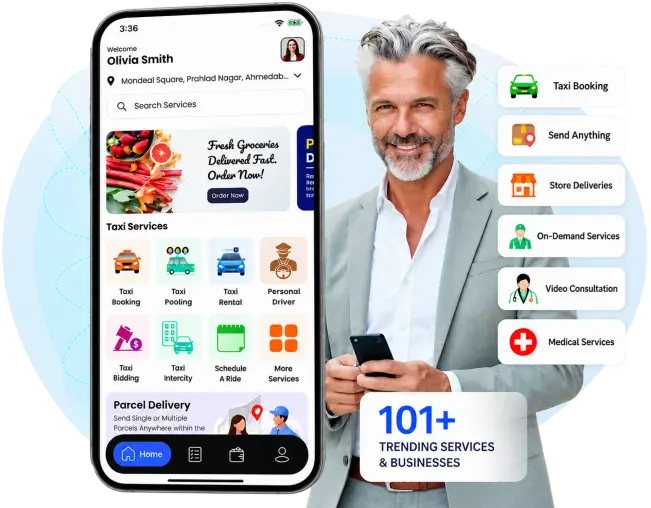
Advantages of Choosing Multi-Service App Solutions
Multiple advantages can be offered by connected applications, starting with a unified identity for different services under the same brand name.
Quick entry to market
The ready-made software provides an existing structure of the application so that startups can devote their time to configuration, testing, and business launch instead of building every component from the beginning.
Many sources of income
A platform can earn money through service commissions, delivery fees, subscriptions, vendor fees, and feature listings. Many different kinds of services create an opportunity to add revenue streams.
Greater interaction with customers
Customers can use various services through a single application. A user who begins by using a platform for transport can later find many opportunities in grocery delivery or domestic services, thus leading to the possibility of repeated use.
Centralized Administration
Having one shared admin dashboard provides a way to track all the bookings, service providers, transactions, and customers’ activity in the respective category.
Less development effort
Ready-made multi-service apps eliminate redundant development efforts. With such a solution, startups can get shared components at their disposal, such as registration mechanisms, payment processing, notification services, and administrative tools.
Simplified business growth
Startups are able to launch services step by step, instead of launching every category at once. Thus, they can find out whether their service is in demand and how to improve it before further launch.
Stages to Implement a Multi-Service App Successfully
Acquisition of software is merely part of the process behind building a successful platform. A well-thought-out implementation process allows start-ups to avoid the wastage of funds and operational difficulties.
Implementation plan
Stage 1: Identify the business model
Determine what services will be provided on the platform, who is the target customer and what is the way the company is going to generate revenue. Start with categories with clear demand locally.
Stage 2: Choose the software solution
Compare providers based on their packs of modules available, options for customisation, licensing terms, source-code access, scalability, and level of support. Take a demo to learn how the software works.
Stage 3: Configure and customise the platform
Add your corporate identity logo, categories of services provided, pricing approaches, commission, payment methods, and any customization settings. Configure screens for customers, providers, and administrators.
Stage 4: Integrate vital services
Link payment gateway, navigation and geographic location services, notifications, and other necessary third-party components of the software. Test the integration at all times and for all operating modules.
Stage 5: Start working with service providers
Enlist drivers, merchants, delivery partners, and other professionals in the project. Specify the areas of service, conditions of activity, means of verification, and terms of commission.
Stage 6: Test and release
Conduct tests with regard to bookings, payments, cancellations, tracking, follow-up activities, and admin processes. Start the project in a few selected regions to analyze the issues before launching it more widely.
Stage 7: Monitor and expand
Analyze the number of bookings, returning customers, activities of service providers, revenues, etc. Use these insights to improve existing services and introduce new categories.
Understanding Multi-Service App Development Costs
The price of launching a On Demand multi-service App depends on several factors, including software type, number of modules used, customisation, integrations, hosting, and the expenses incurred after launching the application.
When estimating the expenses, the viable costs include the following components:
| Cost component | What it includes |
| Software licence | Access to the existing application |
| Customisation | Changes made in branding, product workflows, and features |
| Integrations | Payment, maps, notifications, and APIs |
| Deployment | Hosting and application publishing |
| Maintenance | Updates, bug fixes, and technical support |
| Operations | Marketing, provider onboarding, and customer support |
A commercially available solution would, of course, help to reduce the development-related expenditures. But this does not mean that operational and maintenance costs are excluded from the budget.
How V3Cube Helps Startups Launch a Multi-Service Platform
V3Cube has ready-made clone app solutions that are able to deliver a Gojek Clone based on a multi-service business app. The application comes with an existing foundation that includes customer and service provider apps, in addition to administrative panels for operational management.
Also, it is interesting to note how V3Cube highlights certain AI-related capabilities for selected jobs, including personalised recommendations, automation, and operational analysis.
The key advantage of the connected platform approach is that instead of creating various applications or administrative systems for every service, a startup can pursue a shared foundation with several service modules.
The real advantages will be determined by the selected package, a particular set of available functions, the scope of customization, and the licensing terms. The startup can have a demo of the product to see if it fits its business needs. More details can be found on the V3Cube website.
Conclusion
A white-label multi-service App enables startups to enter the on-demand market by using a connected app that would allow a variety of services and sources of revenue. The right solution has to provide necessary service modules, possibilities for customization, secure integration, and development potential.
If a startup chooses the best software and adheres to the gradual implementation process, it can enter the market faster, understand the requirements, and create a full-fledged service ecosystem over time.
FAQs
Q1. Is a white-label multi-service app suitable for a new startup?
Yes. This application can be used by startups that wish to launch multiple services without the need for them to independently develop every application component required for the application.
Q2. Can additional services be introduced after launch?
Yes, the necessary costs and functionality required for development should be discussed with the service provider.
Q3. How does a multi-service app generate revenue?
Common revenue models are service commission, subscription, delivery price, vendor charges, and fees for paid listing.
Q4. Should startups launch all services at once?
Not at all. Additional services can only be introduced after analyzing requests from customer demand and the performance of the business.