Last Updated on November 9, 2026 by esiteworld
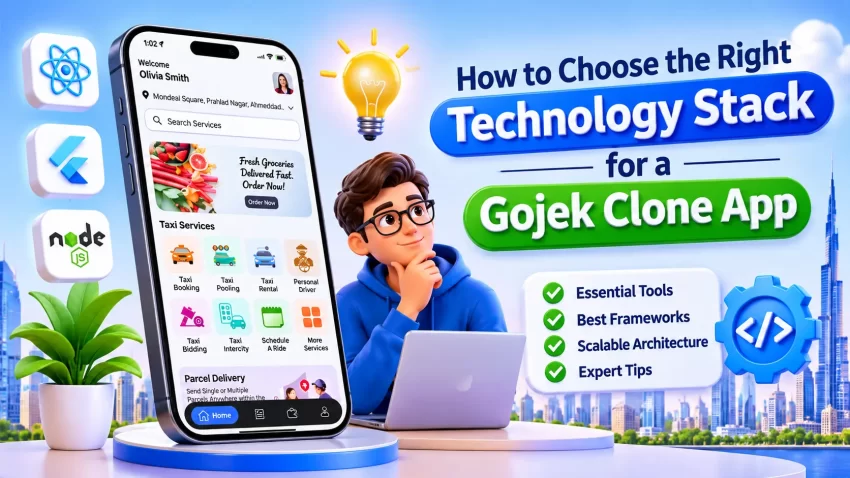
The technology that enables a multi-service platform is key to determining its success in terms of performance, security, and compatibility with business progress. The properly developed Gojek Clone application technology stack allows for building a digital environment that helps connect customers, service providers, and administrators.
Choosing suitable technologies entails much more than using popular programming languages or frameworks. Businesses must also think over how their applications perform, what kind of integrations are possible, how data is managed, the level of security, and the possibility of future growth.
This guide deals with major technology components that must be applied when developing a scalable multi-purpose platform.
What Is a Technology Stack?
The technology stack is defined as a combination of software services which consist of programming languages, databases, frameworks, servers, and various other tools that are necessary to create and operate the application.
For a multi-service platform, the stack generally supports three main applications:
Customer app: A registered consumer can search for the needed service, book it, and make a payment.
Service provider app: Driver, delivery partner, or any service provider can receive requests and manage their income.
Admin panel: The business can control consumers, providers, services, transactions, and generate reports.
All the components are integrated via backend systems and APIs, creating an information flow or communication between consumers and service providers.
Frontend Technologies for a Multi-Service App
The frontend technology influences user engagement with the platform. Applications must provide seamless navigation, responsiveness, and uniform performance over the supported devices.
- Flutter : Building cross-platform mobile applications.
- React Native : Developing Android and iOS applications using a shared codebase.
- Kotlin : Developing native Android applications.
- Swift : Developing native iOS applications.
- React.js : Building web-based administrative dashboards.
Cross-platform technologies allow for the reduction of development work duplication, while native technologies should be used when the project needs to have particular functionality related to its platform specification.
Backend Technologies and Server Infrastructure
The backend is responsible for managing the business logic, linking applications, and processing bookings. It is in charge of bookings, user accounts, service provider availability, payments, notifications, and all administration.
Common backend technologies include:
- Node.js: Suitable for real-time communication and the management of asynchronous operations.
- Python: Good for backend development, corresponding to automation and handling of data.
- PHP: Can be used for web programming and server-side applications.
- Java: Better suited for business applications and advanced backend operations.
- Laravel: A PHP framework allowing the backend development process to be simplified.
Cloud infrastructure is also another important factor. Services such as AWS, Google Cloud, and Microsoft Azure provide many services such as hosting, storage, computing, and monitoring. Selecting infrastructure should be done according to anticipated needs regarding user traffic, requirement of data, budget, and availability.
Database, APIs, and Real-Time Communication
A multi-service application that operates in several functions handles different types of information, such as customer profiles, booking information, details about drivers, information regarding every transaction, as well as a listing of services provided.
Thus, all of this information has to be kept safely and retrieved easily with the help of the database.
Database options
- MySQL and PostgreSQL: A type of relational database for ordered business records and transactions.
- MongoDB: A document-oriented database supporting variable data structures.
- Redis: It is often used to cache data temporarily and accelerate the response time of the server.
APIs and communication
- The API technology enables the interaction among the customer’s application, provider’s application, administrative control panel, and external systems.
- REST API is mainly used to perform standard application requests and updates based on several parameters, and WebSocket technology is great for constant real-time updates.
A suitable combination helps keep information synchronised across the platform.
Essential Integrations for a Gojek-Like Platform
A multi-service platform usually relies on other tools to carry out certain functions. The integrations must be in tune with the services provided and the regions where the business operates.
Some commonly required integrations include:
Maps and navigation:
Google Maps or the equivalent services will help with geo-locations, route directions, and distance calculations.
Payment gateways:
The payment provider is supposed to help with transactions via accepted cards, wallets, and local payment solutions.
SMS and email services:
This includes but is not limited to account validation, confirming bookings, and effective customer communication.
Analytics tools:
The use of business intelligence and analytics services allows monitoring users’ activities, trends in bookings, and service performance.
Not every business needs all types of integrations upon launch. The choice of tools should be based on real operational needs to keep the development process less complex.
How to Select the Right Gojek Clone Tech Stack
An appropriate technology combination depends on the platform’s business model, anticipated use, and growth plans. The following factors should be evaluated thoroughly before determining the architecture:
- Scalability: Is the system capable of accommodating more users, service types, and locations to meet higher demand levels?
- Performance: Can applications handle multiple bookings, location changes and payment requests in a timely manner?
- Security: Does the architecture support reliable authentication, protection of data and processing payments?
- Flexibility in Integration: Is it possible to link payment service providers, maps, and other third-party services to be connected in the time of need?
- Maintenance: Are there suitable support and developers available for continual improvement of the chosen technologies?
- Development Budget: Are infrastructure and licensing costs in line with the project financial budget?
The balanced architecture of the Gojek clone technology should meet present demands while not making future updates unnecessarily difficult.
How Does V3Cube Approach Technology for Multi-Service Platforms?
V3Cube provides businesses with pre-constructed cloned application solutions. These solutions allow them to better assess their potential before committing to developing a complete custom project.
This is highly beneficial to businesses looking for an understanding of how customer apps and service provider solutions will integrate with each other before deciding on the technical scope.
For companies considering Gojek Clone app development, this can help identify which existing capabilities are suitable and where additional technical work may be needed.
It also provides an opportunity to review the architecture and feature demonstration instead of making a decision based only on a feature list or advertised price.
The available solutions from V3Cube can be quite useful for businesses looking for a structured starting point while retaining the ability to discuss modifications according to their operational needs.
During the evaluation phase, businesses need to verify aspects like technology, scalability, ownership terms as well as support and maintenance options.
Common Technology Challenges During Development
A well-thought-out platform might still experience technical problems when it expands. Examples of some common problems include:
- High server load: Having a growing number of bookings affects response time if infrastructure are not properly set up.
- Location accuracy: Poor GPS performance can cause problems with pickups and navigation issues.
- Data security: Poor authentication measures and lack of protection can lead to a leak of sensitive user data.
- Integration failures: Payment and mapping services can have interruptions and compatibility issues.
- App updates: New functionalities should be added without hindering existing business procedures.
A careful evaluation, testing, monitoring, and planning of the right infrastructure will also help tackle these issues. In addition, businesses need to analyze how Gojek Clone development can adapt to evolving service needs in the future.
Conclusion
Selecting a valid technical foundation is very important for developing reliable multi-service platforms. Modern businesses should always strike a balance between security, integration possibilities, application performance, and future scalability when evaluating available technology.
The suitable technical architecture can make daily operations simpler while helping businesses expand.
With careful evaluation of development needs, businesses can find the right technology partner to create a platform that meets the changing needs of customers and the demands faced by operations to provide services.
FAQs
Which programming language is best for a multi-service application?
There is no single best option. Flutter, Kotlin, Swift, Node.js, Python, and Java can all be considered depending on the application’s usage and development goals.
Is cloud hosting necessary for a multi-service application?
Cloud hosting is one of the options, but it allows businesses to get some advantages in computing, storage, monitoring, and managing infrastructure as platform usage grows.
Can the technology stack be changed after launch?
Yes. New technologies and integrations can be updated, although major changes to architecture can require a lot of additional development, testing, and investment.
How should businesses evaluate Gojek-like app technology?
Businesses should compare the options in terms of their performance, security, scalability, integration flexibility, maintenance requirements, and expenses over a time period before selecting a solution.