Last Updated on November 19, 2026 by esiteworld
Today, with the advancement of breakthrough technologies such as AI, it is possible to book an airline ticket by paying through an online payment gateway and purchase your favorite blazer before getting on the flight using a single app!
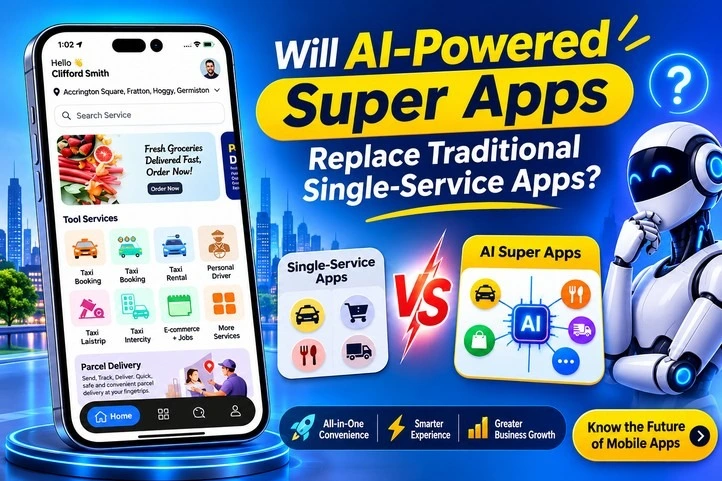
This is the power of super apps. AI-driven multi-service apps will be hot, properly. While the demand for traditional single-service apps will get reduced,
There is a hot debate going on in the post-app era where AI and super apps will slowly but gradually reduce the need for single-service apps. Thanks to their ability to provide conversational, autonomous, and integrated user experiences.
But AI-powered super apps are highly unlikely to entirely replace traditional single-service apps. However, they will absorb several day-to-day tasks and reduce app switching.
Instead of a comprehensive wipeout, the app market is moving towards a complete mix of autonomous agents, unified AI hubs, and specialized apps.
In this write-up, we will deep down into the difference between super apps vs single service apps and how AI integration in super apps is slowly reducing the demand for traditional single apps.
Here we begin!
What is the Simplest Definition of Super Apps?
A super app is a mobile app that integrates multiple services, whether it is eCommerce, messaging, payment processing, food delivery, and many more, using a solo platform.
With the help of super apps, as a user, you can get impeccable and interconnected experiences by ordering various services without having to leave the app.
Good examples of super apps are the Gojek app in Indonesia and Tata Neu in India, which provide e-commerce, financial services, and other lifestyle services in a single platform.
When you have more than 35 apps installed on your smartphone, it is very challenging to find the one service that you wish to avail of.
But instead of these 35 single-service apps, if you have 3 or 4 multi-service apps, it will not fill up space on the home screen of your smartphone. And it will not be cumbersome to search for the service app you wish to shop from.
This is the biggest plus point of super apps.
What are Traditional Single-Service Apps?
Single-service apps, as the name suggests, are the traditional apps that we used to find before the emergence of AI and super apps. During those times, you used to get a single service app which had a specialized role to fulfill.
However, as the technology began, users started questioning about downloading multiple single-service apps on their smart devices. And they were absolutely right!
There was a need for an app to make use of cutting-edge technologies such as AI and ML to ensure that the single-service apps could be upgraded to something more relevant to the times. This is where the emergence of super apps began with the use of AI-driven multi-service apps.
Super Apps vs Single-Service Apps – The Biggest Showdown Starts Here!
| Point of Difference | Super Apps | Single-Service Apps |
| Scope of Services Offered | Integrates multiple services in a single app | Concentrates on a core service in an app |
| Functionality | Serves as a unified ecosystem | Specialized functionality |
| Objective Fulfilled | Supports diverse user requirements | Simple user journey |
| User Experience | A super app balances multiple services and, at the same time, maintains usability and user-friendly navigation. | Traditional single-service apps provide a seamless experience as they concentrate on a single purpose. |
| Customer Retention | Customer retention rate is always high because users can access multiple services from a solo platform. This gives them the opportunity to spend more time using the app. | Single-service apps have a single offering to showcase, which makes users order the service and pay for it before checking out. The customer retention rate depends on how much time does the user takes to order the service. |
| Data Collection and Personalization | A super app accumulates insights from multiple user activities that they made while ordering different services from the app. | A traditional single-service app collects data related to a specific service. For example, a fitness app provides workout regimen and protein supplements, so the data that you can accumulate is only regarding the fitness of people. |
| Revenue Generation Opportunities | A super app creates multiple revenue streams with the help of an integrated ecosystem. It can be payment processing, financial services, advertising, and premium memberships, and many more. | Traditional single-service apps typically generate revenue with the help of a single business model. It can be subscription fees, product sales, advertising, and service commissions |
| Development complexity | Developing a super app is more complex because it requires scalable architecture, API integrations, security frameworks, cloud infrastructure, multi-service coordination, etc. | It is very easy to develop a single-service app. The development team has to focus on solo service, a single workflow, and one customer journey. |
How AI-Powered Super Apps Change Everything?
Today, even when you have a super app, you are still not the best in the business. To be the best, you have to optimally use AI in the multi-service app.
AI agents are changing the game altogether. For example, if your family is planning to visit Switzerland for a long trip of 30 days with a budget of $10,000. Just say this to the AI assistant on your mobile device.
The next thing you will observe is that an AI agent will book the tickets, reserve a hotel near the airport, and add everything to Google Calendar.
All of this is done without you even needing to open multiple apps. AI assistants will communicate with airline services, hotel providers, mapping platforms, payment systems, and your calendar, all without disturbing you.
Here, you did interact with a single conversational interface while AI did everything itself!
This is the basic thing that everyone is afraid of!
These AI assistants have revolutionized our lives altogether. There will come a time when apps will not be opened. Actions will be taken by AI assistants when you instruct them with a command.
For example, while driving home, you may open Siri and tell it to call your wife so that you can ask her to be ready for a ride to her parents.
Next, you open Spotify and give a command to play the list I have saved under my name. Open Gmail and reply to my client and schedule the meeting for next Tuesday. Summarize today’s meetings in action items.
When Should a Business Choose a Traditional Single-Service App?
- If you have a business that concentrates on a single service;
- If you have a constrained budget;
- When you need market validation;
- When your company is launching a new product;
- When the user requirements are highly specialized.
When Should a Business Develop a Super App?
- If your business functions on multiple services;
- When cross-selling opportunities need to be exploited;
- When customer retention is a strategic priority;
- Large-scale growth is expected.
Where Does AI Stand When It Comes to Modern Super Apps?
AI has a definitive role to play when it comes to modern-day super apps. With the help of AI, you can -
- Personalize recommendations just like what Netflix does on its platform, where AI suggests pertinent products and services based on user behavior;
- Make use of AI chatbots for round-the-clock support;
- Forecast customer requirements and purchasing patterns using predictive analytics;
- Make effective use of marketing automation to deliver personalized campaigns instantly.
Conclusion
Both traditional single-service apps and AI-powered super apps have a role to play in today’s digitally vibrant world.
A traditional single-service app provides focused services and quicker development time, which makes it a perfect fit for businesses with a core business service strategy.
AI-powered super apps provide an integrated ecosystem that improves customer engagement, unlocks brand-new revenue generation opportunities, and provides a long-term competitive edge.
We have already discussed when to use which app in this write-up. Remember, the right option can give wings to your business, while the wrong one can hurt your growth strategy in the long term.
If you wish to develop an AI-powered super app such as a Gojek clone, get in touch with a reputed Gojek clone app development company such as V3Cube. Our developers have gained expertise in developing Gojek clone apps with a fast time-to-market.
We assure you that the business idea you discuss with us will remain strictly confidential with us!
FAQs
Q1. Is an AI-powered super app better than a traditional single-service app?
An AI-powered super app is a multi-service app that uses AI to augment its service offerings. On the other hand, a traditional single-service app consists of only one core service with total focus on providing it to the users.
Single-service apps, although rare, are still there in today’s world, but they are losing prominence because AI agents with super apps have taken over the world in a storm.
Q2. What are the revenue streams of a super app?
A super app creates multiple revenue streams using an integrated ecosystem. It can be payment processing, advertising, premium memberships, financial services, and many more.
Q3. Does data collection and personalization work in a super app?
Of course! A super app accumulates insights from multiple user activities that they made while ordering different services from the app.