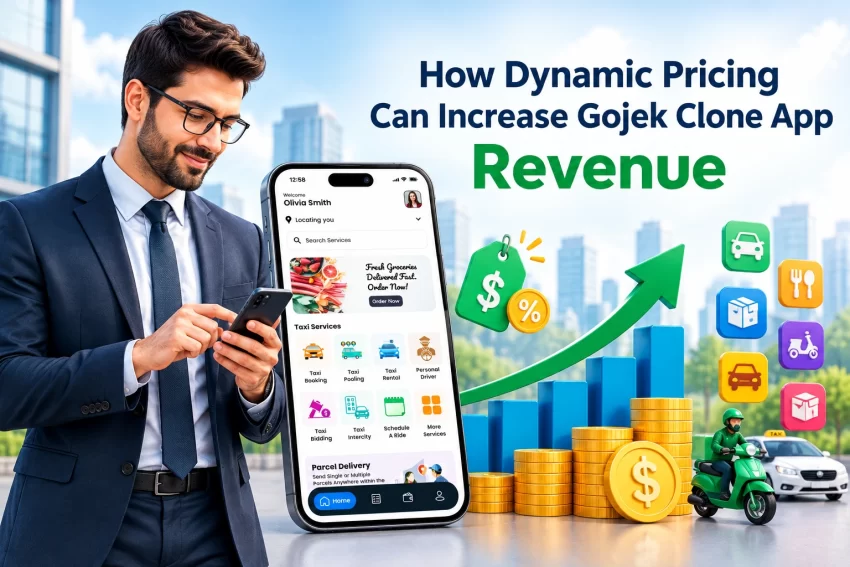
Last Updated on September 9, 2026 by esiteworld
Ever tried booking a taxi during heavy rains and saw a sudden rise in prices? If yes, you would be curious to know why this sudden increase in pricing happens. This write-up will answer this question.
We would also like to inform you how the admins arrived at this pricing and how it can prove to be a blessing for the drivers.
But before we proceed further, let us look at this statistic: as per a report published by ResearchGate, more than 70% of large-scale retail and eCommerce platforms make use of automatic or dynamic pricing to adjust to market changes in real time.
So, what exactly is dynamic pricing, and how does it help in increasing Multi Service App revenue? We will try to answer these questions in this blog.
What is Dynamic Pricing and How Can It Increase Gojek Clone App Revenue?
Dynamic pricing is an automated system that adjusts ride fares in real time live market conditions such as supply and demand.
Whenever a rider faces extreme conditions such as peak demand hours, bad weather, or high traffic, this algorithm boosts the overall transaction value and platform commissions.
Dynamic pricing applies to different services too, but for this example, we are taking the car-riding service so that it makes it easy for you to relate to.
How Does Dynamic Pricing Drive Revenue?
Here are some of the ways a Gojek clone app dynamic pricing drives revenue.
Context-Driven Adjustments
During peak hours, you might have observed a surge in pricing from an algorithm.
These fare changes can be attributed to the number of riders requiring a trip versus the number of drivers online in a particular area.
If the demand is higher but the supply is lower, it can cause real-time adjustments in the Gojek clone app dynamic pricing. This results in a surge in prices.
Advanced AI models take into account rain, holidays, or major local events, where the urgency to book results in more willingness to pay for the riders/people looking for a particular service.
It is a perfect way to balance supply and demand. The higher payouts bring more drivers online, thereby preventing lost revenue.
Surge and Multipliers
During morning rush or heavy rainfall, the app applies a multiplier to the base fare. This causes a surge in the overall pricing that impacts the Gojek clone app revenue.
These multipliers help ensure that drivers get additional incentive to take rides during such scenarios. Along with this, riders also get the assurance that they will ultimately get the ride, albeit at a premium price.
Visual Indicators
There are times when a visual indicator is displayed on the booking screen to highlight the high demand for drivers.
It is nothing but a visual thumbnail that informs drivers that they will get an added incentive in pricing when they opt to accept the ride till the thermometer is displayed.
Cross-Service Application
This applies to different services such as ride-hailing, food, grocery delivery, and courier tasks that scale up the profit margins across every vertical in Gojek clone app monetization.
Reasons To Use Dynamic Pricing in the Gojek Clone App
Here are some reasons that make the use of dynamic pricing in the Gojek clone app essential.
Improves Waiting Times for the riders
During busy hours, the Gojek clone app dynamic pricing feature helps increase the prices of the ride during that particular period. This way, it reduces the wait times for the riders.
At the end of the day, dynamic pricing helps attract the attention of more drivers to use the Gojek platform during the peak hours of the day.
Supports Driver Earnings
The multipliers in the Gojek clone app dynamic pricing feature compensate driver partners for working during the high-traffic rush hours or challenging conditions such as heavy rainfall.
Ultimately, the spike will depend upon different factors like trip distances, time of the day, and location. These fares depend on dynamic pricing; hence, drivers end up earning a substantial amount.
Optimal Management of Operational Efficiency
Smart algorithms present in dynamic pricing features assist in processing millions of real-time data points so that the prices can be adjusted automatically on the basis of time, distance, and location.
Key Components of the Dynamic Pricing Feature
Here are some of the key components that you need to have in the dynamic pricing feature in the Gojek clone app.
AI-Driven Pricing Engine
Using real-time smart algorithms, you can calculate the base distance or time fees for dynamic pricing in the Gojek clone app. The only caveat is that you need to apply multiplier variables on the basis of localized market signals.
Transparent UI/UX Notifications
You must depict thermometers, explanatory text such as high demand in this area or expect longer wait times, along with clear badges, so that the rider comprehends the rise in cost.
Government and Policy Caps
It enforces automated price floors and ceiling prices so that it adheres to the local transport regulations.
Surge Control Limits
Make effective use of controlled algorithms so that there are no extreme price spikes that can cause high customer churn.
Concluding Thoughts
A Gojek clone revenue model allows entrepreneurs and businessmen to have a flexible base for putting their best foot forward in the ride-hailing market.
The best thing about a dynamic pricing feature is that it allows you to create a fresh revenue opportunity by establishing a sustainable monetization model.
If you need any help developing a Gojek clone app, get in touch with a prominent Gojek-like app development company such as V3Cube and see how it helps expand your revenue scale effectively!
FAQs
What role do AI features play in boosting the Gojek clone app ROI?
AI-powered features have a crucial role to play in boosting the Gojek clone app. You can use features such as smart routing, AI dynamic & fair pricing, automated admin reporting and monitoring, and smart promo codes.
What are the key Gojek clone monetization strategies?
The key Gojek clone monetization strategies include subscriptions, listing fees, commission-based earnings, promotions, advertising, and dynamic surge pricing. The Gojek clone app also consists of other AI-based features that assist in boosting revenue, such as automated promos, predictive demand forecasting, etc.
Is it possible to regulate or cap the dynamic pricing feature in the Gojek clone app?
Absolutely! It is possible to regulate or cap dynamic pricing features in the Gojek clone app. The admin has the right to set multiplier limits during emergencies, regulatory requirements, etc with absolutely zero code changes.
What is the revenue model of a gojek clone app?
Being a multi-service app, a Gojek clone app enables businesses to provide multiple services such as taxi booking, food delivery, etc. It also allows them to monetize using commissions, delivery fees, advertising, subscriptions, etc.