Last Updated on July 4, 2026 by esiteworld
The global mobile app development market value in 2026 is close to 300 billion and is likely to reach $606.1 billion by 2032. The 5.83 billion smartphone users spend close to five hours per day on their devices. That’s almost 70% of the population.
This is a gold mine for business planning to invest in mobile app development. With evolving consumer behaviour, one category of app stands out: the multi-service app like Gojek.
The market size of the super app industry in 2025 was USD 121.10 billion. It is projected to become a USD 968.77 billion market by 2033. This market is growing at a CAGR of 30.1%. The Asia-Pacific region is the largest market in 2026.
This article provides further insight into why entrepreneurs prefer a multi-service Gojek clone app in 2026.
What Is a Multi-Service Gojek Clone App?
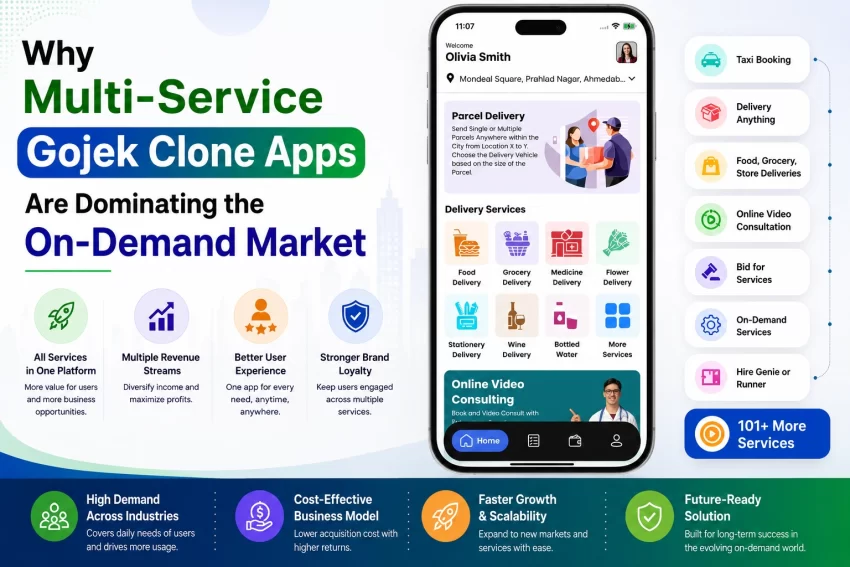
A Gojek clone app is a multi-service app that offers a wide range of services that users commonly require on their mobile devices. This includes apps like taxi services, food delivery, home services, digital payments, and many more.
“The biggest risk is not taking any risk.” — Mark Zuckerberg
Top Reasons Entrepreneurs Prefer Gojek Clone Apps
Here are some of the top reasons why entrepreneurs prefer Gojek clone apps:
All-in-One Revenue Streams Under One Roof
A single Gojek clone unlocks 100+ service verticals. This includes rides, food, groceries, parcels, beauty, home repairs, fitness, and many more; the list is endless. Each vertical generates independent revenue. Hence, entrepreneurs do not need to bet their business on a single service category.
The cross-selling opportunities compound retention and lifetime value. Diversification is not just a financial strategy for super apps; it is the entire business model.
Lower Capital Expenditure, Higher ROI
The financial case for a multi-service Gojek clone app is not subtle. The average cost of a feature-rich custom mobile app development is $100,000+ in 2026. Consider developing multiple apps, one for each service vertical; this will only multiply the cost.
On the other hand, developing a multi-service app that includes several apps like rides, food, and groceries helps eliminate the need to build multiple ones. This helps cut costs by over 60-80%.
But that’s not all, businesses can opt for a white-label Gojek clone app instead, which will cost a fraction of the amount it costs to custom-develop it. This is where the ROI equation becomes compelling. A business operating across five service categories within a single app generates five income streams: commissions, delivery fees, surge pricing, and subscription tiers.
All this from one infrastructure investment. The platform does not cost more because it does more. For entrepreneurs, a Gojek clone is not a cheaper product. It is a more valuable one.
Proven Business Model with Regional Adaptability
Gojek’s model has been battle-tested across Indonesia, Singapore, Vietnam, and Thailand. Clone solutions inherit that structural proof-of-concept. It does not mean it is a copy of the code. It is a mobile app with a similar concept to Gojek, that is fully customisable for local languages, currencies, payment gateways, and regulatory requirements.
Scalability for Enterprise-Grade Growth
A Gojek clone is well designed to ensure it is fit to handle millions of concurrent users. It is in the basic architecture of the app. Entrepreneurs can begin with a single city and a single service.
They can then scale to national or cross-border operations without re-platforming. They can also add as many services as they please. For example, they can start by offering their taxi services in Bangkok. Later, they can expand to food delivery and several other services across other cities in Thailand and venture into Malaysia.
Exponential Growth of the Food Delivery Market
The revenue from the on-demand online food delivery market worldwide in 2026 is likely to rise to $1.51 trillion. It is also expected to further grow at a rate 6.24%.
A major portion of this is from mobile apps; if a business were to start with just the food delivery vertical in the Gojek app, it could benefit immensely.
But that’s not all, this applies to the entire on-demand industry. The market size of on-demand apps at the start of 2020 was $9.1 billion; this is projected to rise to $75 billion by 2030, growing at a rate of 21.1%.
The Asia-Pacific (APAC) region is witnessing the fastest growth in the on-demand industry. For example, another on-demand vertical, ‘Home Service,’ is also very popular. This market is expected to rise to USD 14.7 billion by 2030.
Lifestyle of Consumers
Businesses can also benefit from the evolving lifestyle of consumers. This includes an increased use of mobile devices and a greater dependence on mobile apps to buy products. Besides this, a growing number of people prefer to use on-demand apps.
Industry Case Study
Here is a case study that showcases the potential of the super app business solution – Gojek.
Mr.Franck from West Africa chose V3Cube when it came to developing a Gojek clone. V3Cube delivered the application customized to their requirements, allowing them to launch within 2 weeks.
His goal was to consolidate ride-hailing and home services under one app. With V3Cube’s white-label solution, he avoided the 18-month custom development cycle his original plan required, went live within weeks, and began acquiring service providers within the first month of launch. The fully branded and localised Gojek clone app positioned him ahead of fragmented single-service competitors in the region.
V3Cube has established itself as a leading enterprise provider of ready-made, AI-powered on-demand app solutions for global markets. Their flagship on-demand AI-Powered multi-service app, the XJekPlus, supports 101+ service verticals and ships with intelligent pricing, automated payouts, fraud protection, and voice booking built in.
Benefits of Developing a White-Label Gojek Clone App
The Gojek-style app is not a new concept. However, there are plenty of opportunities, especially in the Southeast Asia market. As the saying goes, “Better late than never”.
By opting for a white-label Gojek clone app, a business can benefit in many ways. They can launch within 2 weeks; spend a fraction of the amount it would take for custom Gojek clone app development. Have instant access to over 100 verticals with the option of starting with one and later scaling seamlessly.
Order your white-label Gojek clone from V3Cube today and take advantage of the advanced AI-Powered features.
FAQs
1: What is a Gojek clone app?
A Gojek clone app is a multi-service platform that replicates the functionality of the Gojek super app. The services include ride-hailing, food delivery, home services, and payments.
2: How much does a Gojek clone app cost?
Pricing varies by provider and feature set, but white-label Gojek clone solutions are typically 60–80% less expensive than building from scratch. Costs generally range from a five thousand to ten thousand dollars, depending on customisation scope and support requirements.
3: How long does it take to launch a Gojek clone app?
With a proven provider like V3Cube, a Gojek clone can be configured, branded, and deployed in as little as two weeks. This is dramatically faster than the 12–18 months typically required for custom multi-service app development.
4: Can a Gojek clone app be customised for local markets?
Yes, the white-label Gojek clone platforms are fully customisable. They tend to offer support for various local languages, currencies, payment gateways, and regulations.
5: Why do entrepreneurs prefer Gojek clone apps over building from scratch?
The combination of dramatically lower cost, faster time-to-market, a proven business model, and enterprise-grade scalability makes Gojek clones the strategically sound choice for entrepreneurs who need to capture market opportunity quickly without the capital burden of ground-up development.