Last Updated on July 4, 2026 by esiteworld
The FIFA World Cup 2026 starts in less than 8 days in the US, Canada, and Mexico. This is the perfect scenario to understand what “delivery” means in 2026 and why tracking metrics is crucial.
It includes millions of fans, many experiencing American cities for the first time, ordering food from stadium concourses, requesting pharmacy items from hotel rooms, and getting match-day merchandise delivered to their seats. They are ordering from a train to a venue, from a rideshare mid-journey, from gridlocked traffic outside MetLife Stadium.
Delivery is no longer a transaction that happens at a front door. It happens everywhere humans are in motion, in crowds, in the middle of life. Southeast Asia, with its congested megacities, fragmented retail, and mobile-first consumers, is entering a new phase. The 2020s have been termed the ‘delivery decade’ for a reason.
Entrepreneurs have the perfect opportunity to launch their version of a multi-store delivery solution like the Deliveroo Clone app. However, the ones that succeed will not be the ones that focus on offering the best features. It will be those who leverage AI-powered logistics and data analysis and track the right metrics. If you cannot measure it, you cannot scale it, and in delivery, you certainly cannot defend it.
” What gets measured gets managed.” — Peter Drucker
What Is a Multi-Store Delivery App?
A multi-delivery app, as the name suggests, is an on-demand logistics marketplace that allows customers to order a wide range of products from multiple merchants.
For example, customers may order food, have groceries delivered, or request medication from a pharmacy. The use cases are endless.
Businesses have the option to develop their multi-delivery app faster by choosing to build an app like Deliveroo. This replicates the architecture of the well-established app, thus allowing entrepreneurs to lay their hands on a market-ready solution.
Furthermore, they can buy a white-label Deliveroo clone instead of spending 18 months developing a custom multi-store delivery app.
Significance of Tracking Metrics of a Multi-Store Delivery App
Tracking metrics is vital not just to boost the efficiency of your platform and ensure growth; it is also essential to prevent cancellations and bad reviews.
At the end of the day, all it takes is a single unfulfilled order or unsatisfied customer to trigger a cascade of bad events. This usually means a negative review, churn risk, driver penalty, merchant dissatisfaction, suppressed algorithmic ranking, and financial loss.
Tracking the real-time metrics sheds light on the main KPIs and allows founders to diagnose failures and prevent them. It also helps forecast demand or present defensible unit economics to investors.
“The goal is to turn data into information, and information into insight.” — Carly Fiorina, Former CEO, Hewlett-Packard.
The Core Metrics to Track for Multi-Store Delivery App Success
There is more to an all-in-one store delivery app than just the customer app to request delivery of their product. It consists of four basic components: the customer panel, the store panel, the driver panel, and the admin panel.
Hence, when it comes to tracking the metrics, it is important to consider a wide range of factors and not just the metrics pertaining to the customer.
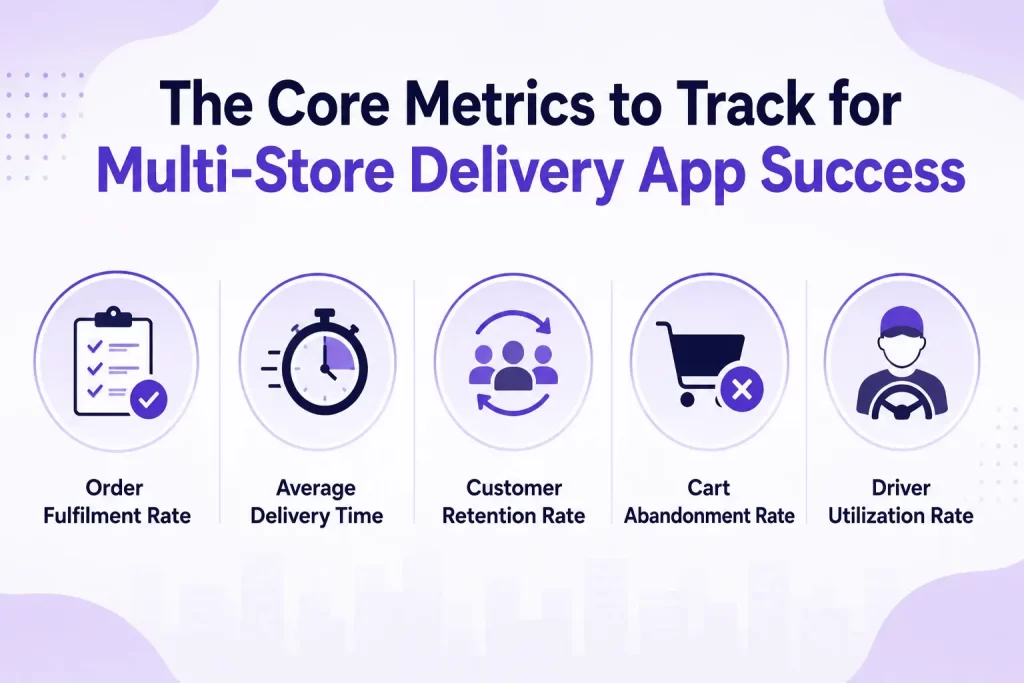
These can be metrics like total orders processed, best-performing stores, driver ratings, customer lifetime value, and AI-Powered demand forecasting. Here are the core multi-delivery app and Uber Clone metrics to track.
- Order Fulfilment Rate: This is the percentage of placed orders successfully delivered within the promised window. The ideal target would be “≥ 95%,” and a rate below 92% would ideally signal a systemic breakdown in driver allocation. The benefits of doing so include merchant readiness, good routing logic, and verifying customer satisfaction.
- Average Delivery Time: Mean duration from order confirmation to doorstep delivery. Category benchmarks in Southeast Asia: 28–35 minutes for food; 45–60 minutes for groceries. Every minute above the benchmark erodes NPS.
- Customer Retention Rate: This is easy to find and is done by calculating the percentage of first-time users reordering within 30 days. A figure below “30%” means the stats are not in your favor. It can mean a broken product-market or an issue with the onboarding experience.
- Cart Abandonment Rate: This is an important metric to track, since it indicates the percentage of users initiating the cart checkout but not going through with the purchase. A rate of above 65-70% typically indicates an issue with your system. It could be the delivery fee, payment method issues, or a badly designed checkout experience.
- Driver Utilization Rate: This figure provides a good picture of how well your system utilizes the driver’s services. It compares the active delivery hours with the total driving hours logged. The optical range would be 70-80%, hence it is best to monitor for ‘over’ and ‘under’ utilization to boost performance.
The admin panel is the multi-store delivery app owner’s best friend. This is where they can track various parameters and ensure your store is on track. It allows entrepreneurs to monitor several metrics like customer acquisition, order performance, store performance, driver and fleet performance, financial metrics, and much more.
” We are not focused on the optics of the next quarter; we are focused on what is going to be good for customers. ” — Jeff Bezos.
Deliveroo Clone’s Success Depends on the Right App Foundation
Tracking the right metrics begins with selecting a platform architected to capture them. However, building a custom multi-delivery store might not be the right way for entrepreneurs to approach this issue.
Launching a feature-rich solution fast is just as important as ensuring it has all the tracking mechanisms in place. An app like this will have features necessary for a food delivery app, document delivery, and much more.
V3Cube has the perfect solution for developing a multi-store delivery app like Deliveroo. They offer a white-label Deliveroo clone app that is ready to launch within 2 weeks.
The icing on the cake is that, besides including an admin panel that allows business owners to track the necessary metrics, it also includes top-notch AI-Powered features. Order a Deliveroo Clone Script from V3Cube today to gain a competitive advantage.
FAQs
1. What is the most important metric for a multi-store delivery app?
A multi-store delivery app that provides a wide range of services, but the most important metric is “Order Fulfillment Rate”. This provides a good overview of customer trust, merchant satisfaction, and the reputation of the platform itself. For a multi-store delivery app, this metric can set a baseline, however, this does mean the other metric are not necessary.
2. How does a Deliveroo clone differ from a single-restaurant app in terms of analytics?
Both apps serve the same purpose; however, the chief difference is that the single-restaurant app will not have the multiple merchant functionality. A single-restaurant app will allow users to exclusively order food products from one restaurant. On the other hand, with a Deliveroo clone app, the user will have the option to browse several restaurants before placing the order.
3. What KPIs should I track at launch for my delivery app?
The most important KPIs to track during the launch of the app include: order fulfillment rate, app install-to-order conversion rate, and customer satisfaction score. These metrics will offer the delivery app owner a good overview of the acceptance and initial success of the app making it a vital KPI to keep track of.
4. How do I reduce cart abandonment on my delivery platform?
Some of the main reasons for cart abandonment include a bad user interface, a lengthy checkout process, and a lack of payment options. Audit the checkout flow to determine the cause. Making the checkout process as simple as possible with the least number of steps is bound to do the trick.