Last Updated on June 19, 2026 by esiteworld
When most companies launch a taxi booking platform, they usually stick to the standard flow where a user requests a ride, gets dropped off, and pays the fare.
While that basic model gets the business off the ground, it leaves a big part of the market completely untouched.
For the person running the platform, this completely changes how the taxi booking app brings in revenue.
In a regular setup, a driver drops someone off, gets a single fare, and immediately goes back to staring at their phone, hoping another ride request comes through.
While that works fine for quick trips around the city, it doesn’t help the user who needs a car for a whole afternoon of running between client offices, managing a busy wedding day, or taking an elderly parent to a hospital appointment where they have to wait.
If your app doesn’t have a way to book a driver to stick around for that waiting time, the user is just going to close it and look for a platform that does.
These are not rare situations; they are everyday needs for people who are willing to pay for the convenience.
Just look at the corporate side of things, where companies are spending around $47 billion globally on ground transportation to get their teams around.
A lot of top-tier businesses today expect dedicated drivers for their executives, and if your app only does quick pick-ups and drop-offs, you simply don’t exist to these clients, leaving them entirely to the competitors who actually bothered to update their software.
That is exactly why having a feature to hire a driver isn’t just a luxury add-on anymore.
It isn’t there to replace your regular everyday taxi bookings, but rather it sits right there in the same app alongside them, ready to catch those longer trips that your business would have completely missed out on if the feature wasn’t there in the first place.
How the Hire a Driver Feature Works in an Uber Clone App
If you look at how this feature actually works in a solid Uber clone app today, the process is built to be simple for everyone involved.
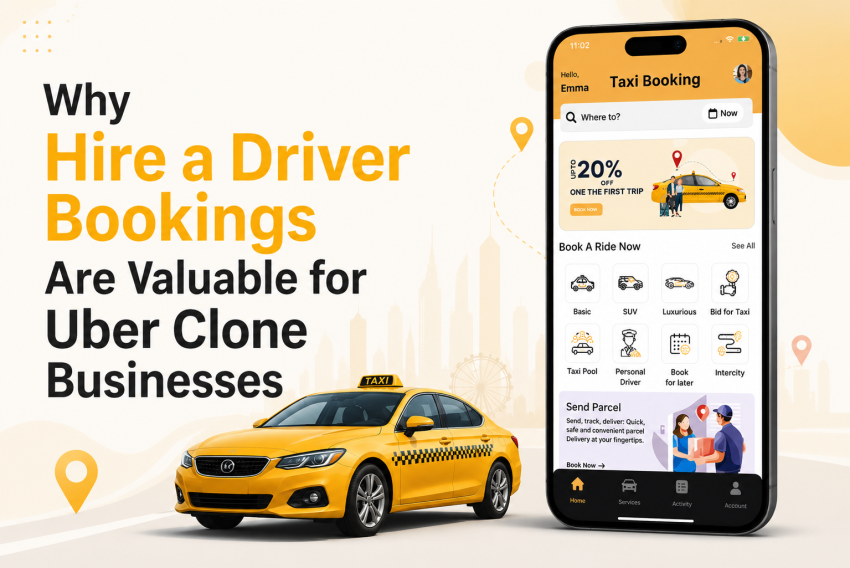
Instead of just typing in a single drop-off point and hoping for the best, the user opens the app, selects the option to hire a driver, chooses the type of car they want, and simply books the driver for a set number of hours.
The app then calculates the cost based on your hourly rates and sends the request to drivers who are looking for longer trips.
For the driver who accepts it, this changes their whole day because instead of stressing over finding their next small ride, they get a guaranteed block of time where they know exactly what they will be doing and earning for the next few hours.
Meanwhile, the user gets the freedom to make as many stops as they need, change their route as they go, or even add more time directly from their phone.
On the backend, the business owner still has complete control to set up the hourly rates and minimum booking times that actually make sense for their specific city.
And because users can just tap to extend their hours during the trip, the platform naturally brings in more revenue without anyone having to negotiate or argue over the extra cost on the spot.
Does this Feature Boost Profits for the Business?
When you look at the actual money being made per hour, the difference is huge.
Users don’t want to calculate complicated pricing before they book, so having a flat hourly rate with a clear minimum amount of time gives them an exact idea of what they are going to spend right from the start.
You also let them choose the type of car they want, whether it’s a basic car for running errands or a luxury vehicle for corporate clients who are willing to spend more.
As the global ride-hailing market grows toward $798 billion by 2035, these are exactly the kind of premium users who bring steady revenue to the platform and help the business survive.
The only issue here is that when a user pays a higher price, they expect a much better experience in return.
You can’t just send over a driver who is used to rushing through quick city trips and expect the user to be completely happy with it.
A good Uber clone backend lets the business owner decide exactly who gets these long hourly jobs by setting up filters, so only the most experienced and top-rated drivers even see the requests on their screen.
This keeps the service quality high without affecting how your regular everyday fleet operates.
Final Thoughts
The easiest way to lose all of these bookings, though, is by making the process confusing or making it feel like it is a completely different app tacked onto your main platform.
Everything needs to stay integrated in one place so that upgrading to a dedicated driver is just a simple option right on the home screen.
Because the moment a user gets confused or feels like booking a driver by the hour is too much work, they just close the app, and you lose a profitable ride that you could have easily secured if the flow was simpler.
FAQ
1. What’s the real difference between a regular ride and hiring a driver by the hour?
A standard ride is just a quick hop, the driver drops you off and immediately speeds away to find the next person. But when you hire by the hour, you book the driver and the trip is done for a specific amount of time.
2. Do I need to build a totally separate app to offer this?
Absolutely not. If your Uber clone is built correctly, this should live right inside your main app. It just acts as a different booking mode. The user taps a button, the screen gracefully shifts to hourly pricing, and the backend handles all the complicated logic without anyone feeling like they left the original platform.
3. How does this actually help my drivers make more money?
Standard trips force drivers to constantly hustle, wasting precious time driving to pickups and waiting for new requests. An hourly hire gives them a solid, uninterrupted block of paid time. Even on a slow, dead afternoon, a single hourly booking guarantees they walk away with a fantastic shift instead of an empty wallet.